
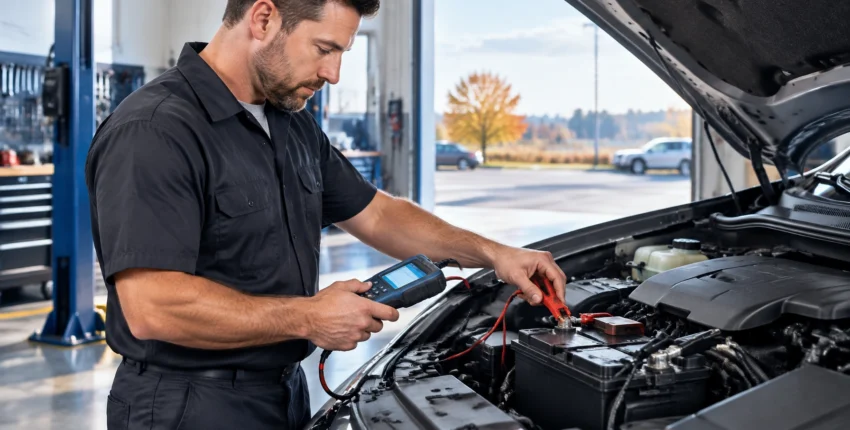
Your car battery can seem perfectly fine on a mild afternoon, then struggle to start when temperatures drop overnight. That’s because cold weather makes a weak battery’s job harder just when your engine needs more power to turn over.
The first freeze often arrives in late October to November, though the timing varies from year to year. Testing your battery now (before you’re facing a no-start on a freezing morning) can help you plan a repair instead of reacting to a breakdown.
Why cold weather challenges your battery
A car battery stores and releases energy through a chemical reaction. Cold temperatures slow that reaction, reducing the power a battery can deliver. At the same time, cold engine oil becomes thicker, so the starter needs more effort to turn the engine.
Think of it like trying to run with stiff muscles: the job takes more energy just when your body is less ready to provide it. A healthy battery may handle the extra demand without trouble. A weak or undercharged one may not.
That’s why a battery that started your vehicle reliably all summer can falter at the first cold snap. The change in weather may not have caused the underlying weakness; it may simply reveal it.
Warning signs your battery may be weakening
Your vehicle often gives you clues before the battery stops working. Pay attention to what you hear, see, and smell.
- Slow cranking: The engine turns over more slowly than usual, especially during a cold start.
- Dim or flickering lights: Headlights or interior lights appear dim, particularly when starting the engine.
- Battery warning light: A warning on your dashboard may indicate a charging-system problem. It doesn’t necessarily mean the battery alone is at fault.
- Corrosion around the terminals: White or bluish buildup can interfere with the electrical connection. Corrosion is a reason for inspection, not proof that the battery must be replaced.
- A swollen or damaged battery case: Bulging, cracks, or leaking fluid require prompt professional attention. Don’t try to charge or jump-start a damaged battery.
- A battery that’s three years old or older: Age alone doesn’t tell you whether it’s failing, but it’s a good reason to have it tested before winter.
A repeated need for a jump-start is another sign to act. A jump may get the engine running, but it doesn’t identify why the battery went flat or confirm that the charging system is working properly.

Why appearance alone can’t tell you if a battery is healthy
A battery can look clean and still be too weak to start your vehicle. Similarly, light corrosion doesn’t automatically mean the battery has failed. Visual checks help identify visible damage and connection problems, but they don’t measure how well the battery performs under demand.
That’s where a professional battery test helps. A technician uses modern testing equipment to assess the battery’s condition and ability to deliver starting power. The result helps determine whether it needs replacement or whether another issue is affecting performance.
If you’re looking for auto repair in Bonne Terre, MO, a measured test is a more dependable starting point than guessing based on age, appearance, or one difficult start.
What happens during a battery and charging-system test?
A battery doesn’t work alone. Its cables, connections, starter, and charging system all play a part in getting your vehicle started and keeping the battery ready for the next drive.
A professional inspection may include:
- Checking the battery and connections. The technician looks for damage, corrosion, loose connections, and other issues that could interrupt electrical flow.
- Testing battery performance. A battery tester evaluates how well the battery can supply starting power. This can reveal weakness that isn’t visible from the outside.
- Checking the charging system. The technician assesses whether the alternator and related components are maintaining the battery as designed.
- Considering the vehicle’s needs. Late-model vehicles can use sophisticated electrical and charging systems. The test and diagnosis should account for the vehicle, rather than relying on a one-size-fits-all guess.

At Autocenters Service, ASE Blue Seal of Excellence certified technicians bring more than 14 years of experience to vehicle service. Modern diagnostic and testing equipment helps the team assess late-model vehicles and explain what the results mean. Learn more about our general maintenance services and technicians.
When should you replace the battery, and when should you test first?
Test first if the battery is older, the engine cranks slowly, lights seem dim, or the vehicle has needed a jump. A test can show whether the battery is still performing adequately and help identify a charging or connection issue.
Replacement may be appropriate if testing confirms the battery can no longer provide the power your vehicle needs, or if the case is swollen, leaking, or damaged. A visibly damaged battery should be assessed promptly; don’t wait for the next cold morning.
If the battery passes, that’s useful information too. Your technician can still check whether the charging system, cables, or another starting component needs attention. Replacing a battery that isn’t the cause may not solve a starting problem.
For maintenance guidance tailored to your vehicle, check its owner’s manual and the manufacturer’s recommended service schedule. If you’re unsure what a test result means, ask the technician to walk you through it before approving work.
What can happen if you ignore the warning signs?
Imagine heading out on a freezing morning, turning the key, and hearing only a slow click. A weak battery can leave you stranded at home, in a parking lot, or while traveling. Testing before the cold sets in gives you more time to make an informed decision.
Jump-starting can be useful in the right situation, but it isn’t a substitute for diagnosis. Incorrect connections or reversing the cables can cause injury or damage vehicle electronics. Follow your owner’s manual and the jump-starter instructions, and never attempt to jump-start a battery that’s swollen, leaking, visibly damaged, or possibly frozen. If you’re uncertain, call for professional help.
A deeply discharged battery also shouldn’t be treated as if a short drive will reliably restore it. Repeatedly asking the alternator to recover a severely depleted battery can place extra demand on the charging system. A technician can determine whether the battery needs replacement, proper recharging, or further testing of the alternator and related components.
Schedule a battery test before the first cold morning
If your battery is three years old or more, your engine cranks slowly, or you’ve needed a jump-start, don’t wait for a colder day to find out whether the system is ready. A battery and charging-system test is a straightforward maintenance step that can help you avoid an unexpected no-start.
A mechanic in Bonne Terre, MO can test the battery, check the charging system, and explain your options. Autocenters Service offers fast turnaround, flexible financing for eligible repairs, and a nationwide TechNet warranty on parts and labor, subject to applicable terms.
Book a battery and charging-system test, or call 573-226-9500. We’re here to help drivers in Bonne Terre, MO and neighboring areas prepare for colder weather with safety, efficiency, and peace of mind.